Early Signs of Carpal Tunnel Syndrome: What to Watch For Before It Gets Serious
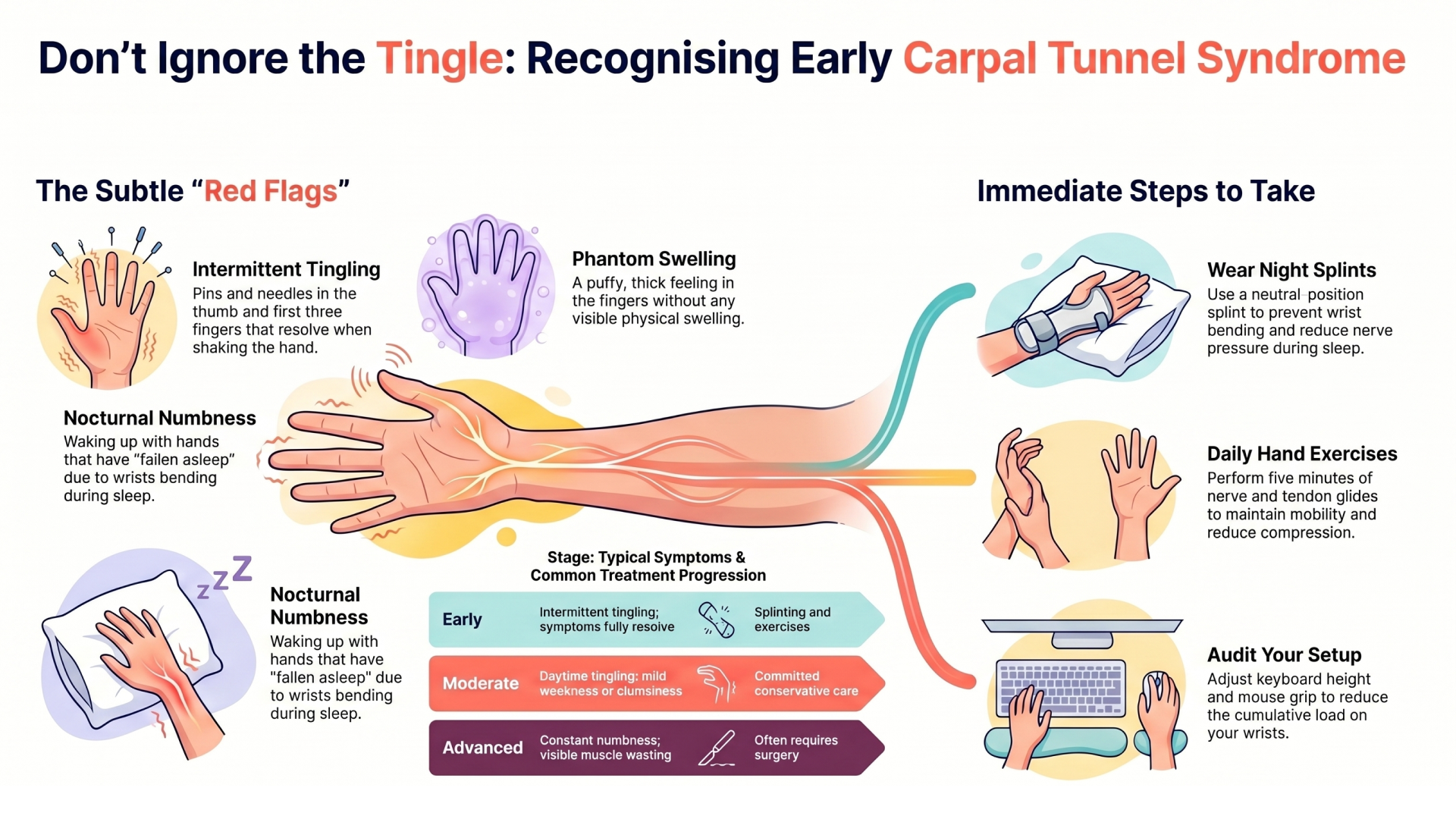
Most people don't recognise carpal tunnel syndrome in its early stages. The first symptoms are vague - a bit of tingling here, occasional stiffness in the morning, a hand that falls asleep faster than usual. Easy to brush off. Easy to blame on a bad sleeping position or a long week at the desk.
That dismissal is exactly how mild carpal tunnel becomes serious carpal tunnel.
The condition is highly treatable in its early stages - often with nothing more than a wrist splint, a few targeted exercises, and some adjustments to how you work. But the window where those simple interventions are enough doesn't stay open forever. The longer nerve compression continues, the more damage accumulates, and the harder recovery becomes.
This post is for people who suspect something is off with their hands but aren't sure if it's worth paying attention to. The short answer: if you're asking the question, it probably is.
Carpal tunnel syndrome caught in the early stages can often be fully resolved without surgery. The same condition left untreated for years frequently requires it.
Why Early Carpal Tunnel Is So Easy to Miss
Carpal tunnel syndrome doesn't announce itself. There's no single moment when everything changes - it creeps in gradually, and the early symptoms overlap so heavily with normal tiredness and overuse that most people rationalise them away.
A few reasons the early signs get missed:
They're intermittent: early symptoms come and go. You'll have a bad night, then two good ones, and convince yourself it was nothing.
They're easy to attribute to something else: "I slept on my arm wrong," "I've just been on my phone too much," "I overdid it at the gym." All plausible. All ways to avoid dealing with what's actually happening.
They don't feel serious: tingling is annoying, not alarming. Pain that resolves on its own doesn't feel urgent. The urgency only becomes clear in retrospect, when things have progressed.
There's no obvious injury: carpal tunnel develops from cumulative load, not a single event. Without a moment you can point to as the cause, it's hard to take seriously.
None of this means you're being careless - it's the predictable result of how the condition develops. But knowing the pattern means you can catch yourself doing it.
The Early Warning Signs of Carpal Tunnel
1. Tingling or numbness that comes and goes
The first symptom most people notice is an intermittent tingling - like mild pins and needles - in the thumb, index finger, middle finger, or ring finger. It tends to appear during or after activities that involve sustained hand use: typing, driving, using a phone, holding a book.
At this stage it resolves quickly when you stop the activity or shake your hand out. That quick resolution is why it gets dismissed - but it's also what makes it recognisable as an early nerve symptom rather than general fatigue. Tired muscles ache. Compressed nerves tingle.
The little finger being unaffected is an important detail. Carpal tunnel syndrome follows the median nerve distribution, which doesn't include the little finger. If your little finger is tingling too, a different condition may be responsible.
2. Waking up with numb hands
Nocturnal symptoms are often the first thing that prompts people to take carpal tunnel seriously, even though by the time they appear, the condition has usually been developing for a while.
Most people sleep with their wrists bent - tucked under a pillow, curled at the chest, pressed against a mattress. Wrist flexion increases pressure inside the carpal tunnel significantly. Hold that position for several hours and the median nerve gets compressed long enough to produce noticeable symptoms.
The early version of this is waking up with a hand that's fallen asleep and returning to normal within a minute or two of shaking it out. That brief window before sensation returns is a signal worth noting.
3. A feeling of swollen fingers - without any swelling
This is one of the most commonly overlooked early symptoms. People describe it as a puffy, thick feeling in the fingers - like they're slightly swollen or stiff - particularly in the morning. They check their hands, see no swelling, and conclude nothing is wrong.
What they're feeling is a neurological phenomenon: the disruption to normal median nerve signalling alters how the brain processes sensory information from those fingers, creating the perception of swelling or fullness that isn't there physically. It's subtle, but it's real - and it's an early indicator of nerve involvement.
4. Dropping things more than usual
Early grip weakness often shows up as a general sense of unreliability in the hand rather than dramatic loss of strength. You're dropping your phone more than you used to. A mug slips. You fumble with keys. Each incident seems random and minor.
What's actually happening is that the median nerve controls the muscles at the base of the thumb (the thenar muscles), and early compression affects these muscles before the weakness becomes noticeable in everyday tasks. By the time you're consciously aware of reduced grip strength, the condition has typically moved beyond the earliest stage.
5. Difficulty with fine motor tasks
Buttoning a shirt that feels slightly more difficult than it used to. A phone screen that your fingers don't navigate as precisely. Handwriting that feels less controlled. These are early signs that finger dexterity and fine motor coordination are being affected.
Fine motor function is among the first things to degrade under median nerve compression because the precise finger movements it requires depend heavily on both sensation and fine muscle control - both of which the median nerve supplies.
6. Pain or aching that extends up the forearm
Carpal tunnel pain doesn't always stay in the wrist and hand. In early stages, many people describe a dull aching that travels from the wrist up toward the elbow, often appearing after prolonged desk work or at the end of a long day. It can feel like general forearm fatigue - which is why it rarely gets flagged as a nerve symptom.
The distinction worth noting: carpal tunnel pain tends to be felt along the inner (palm-side) forearm, following the path of the median nerve. Pain that's more lateral or involves the elbow joint itself more likely has a different cause.
7. Symptoms triggered by specific positions or activities
Early carpal tunnel is positional and activity-dependent in a way that advanced carpal tunnel isn't. You'll notice it appears predictably during certain things - holding a steering wheel, using a mouse for long periods, scrolling on a phone - and resolves fairly quickly when you stop.
This predictability is diagnostically useful. If you can reliably reproduce your symptoms by holding a specific position, that's valuable information for both self-management and for a clinical assessment.
The early stage is defined by symptoms that come and go. The progression to moderate and advanced carpal tunnel is defined by symptoms that stop going away.
The Difference Between Early, Moderate, and Advanced Carpal Tunnel
Understanding where you are in the progression helps you know how urgently to act and what kind of treatment to pursue.
Early stage
Symptoms are intermittent - they appear and then fully resolve
Mostly nocturnal - night and morning are worse than the day
No persistent weakness or loss of sensation
Shaking or repositioning the hand brings quick relief
Conservative treatment (splinting, exercises) is highly effective
Moderate stage
Symptoms are more frequent and take longer to resolve
Tingling begins to appear during daytime activities, not just at night
Mild but noticeable weakness or clumsiness in the hand
Some reduction in sensation starting to develop
Conservative treatment still effective but requires more commitment
Advanced stage
Numbness is constant - it no longer fully resolves
Significant weakness affecting grip and pinch strength
Visible wasting of the thenar muscle at the base of the thumb
Reduced sensitivity to touch and temperature in the affected fingers
Surgery is often the most appropriate treatment at this stage
Most people who end up needing surgery spent years in the early and moderate stages ignoring symptoms that were telling them something was wrong.
Who Is Most Likely to Miss Early Carpal Tunnel
Certain groups are both at higher risk of developing carpal tunnel syndrome and at higher risk of dismissing the early signs:
Developers and office workers: used to hand fatigue from long days at the keyboard, early carpal tunnel symptoms blend easily into the background of normal tiredness.
Gamers: high-intensity hand use is normalised; symptoms during or after sessions are attributed to the session rather than nerve compression.
Musicians: hand discomfort is so common in regular practice that early nerve symptoms rarely stand out.
People in physically demanding jobs: general hand and wrist fatigue is expected, making it hard to identify when something has crossed into a clinical problem.
Pregnant women: hand swelling and general discomfort are attributed to pregnancy, and the specific nerve symptoms of carpal tunnel go unrecognised until they become severe.
If you're in any of these groups, the bar for paying attention to hand symptoms should be lower, not higher.
What to Do If You Notice Early Signs
You don't need a diagnosis to start protecting your hands. The moment you notice recurring tingling, intermittent numbness, or any of the other early signs above, a few simple steps can halt the progression:
Start wearing a wrist splint at night: this is the single most effective early intervention and you can start tonight. A neutral-position splint prevents the wrist bending that drives nocturnal symptoms and gives the nerve a chance to recover during sleep.
Begin a daily hand exercise routine: nerve glides, wrist stretches, and tendon gliding exercises maintain nerve mobility and reduce compression. Five minutes a day at this stage can prevent months of treatment later.
Audit your setup and habits: look at keyboard height, mouse grip, phone holding position, and how long you go without a break. Small ergonomic changes at this stage have an outsized impact.
Start logging your symptoms: note when symptoms appear, how long they last, what triggered them, and how severe they are. This turns vague discomfort into useful data - both for your own awareness and for a doctor if you need one.
See a GP if symptoms persist beyond 4–6 weeks: early-stage carpal tunnel is straightforward to diagnose and treat. Getting a clinical assessment sooner rather than later opens up all your options while they're still on the table.
You don't need to wait until it's serious to take it seriously. The best time to act on carpal tunnel is the moment you first notice something is off.
Start Tracking Your Symptoms
Catching carpal tunnel early is largely a matter of paying attention - and tracking makes that much easier. When you log symptoms consistently, patterns that seem random become clear: the time of day symptoms peak, which activities trigger them, whether they're getting better or worse week to week.
CarpalCare is a free app designed to do exactly this. The pain journal lets you log symptoms in seconds with visual hand mapping, the exercise library includes nerve glides and stretches specifically for early carpal tunnel management, and the weekly analytics show you your trend over time. If you need to see a doctor, the app generates a PDF report of your symptom history to bring with you.
Free on iOS and Android. No account needed.
The window where simple habits make all the difference is open right now. Don't wait until it closes.
Frequently Asked Questions
What are the very first signs of carpal tunnel syndrome?
The earliest signs are usually intermittent tingling or numbness in the thumb, index, and middle fingers - particularly during activities involving sustained hand use, or when waking up in the morning. A feeling of swollen fingers without visible swelling is another commonly overlooked early indicator.
Can you have early carpal tunnel without pain?
Yes. Pain is not always present in early carpal tunnel syndrome. Many people experience tingling, numbness, and mild weakness before pain becomes a feature. The absence of significant pain is one reason early carpal tunnel is so frequently dismissed.
How do I know if my tingling is carpal tunnel or something else?
Carpal tunnel tingling follows the median nerve distribution: thumb, index finger, middle finger, and half of the ring finger. If your little finger is affected, or if symptoms extend up the arm from the shoulder or neck, another condition may be responsible. A GP or hand specialist can assess and confirm the cause.
Can early carpal tunnel be reversed?
Yes - early carpal tunnel syndrome is often fully reversible with conservative treatment. Consistent nightly splinting, daily hand exercises, and activity modification can resolve symptoms completely in many people with early-stage carpal tunnel, without the need for injection or surgery.
How quickly does carpal tunnel progress if untreated?
Progression varies significantly between people. Some remain in the early stage for years with slow progression; others move through stages relatively quickly, particularly if the contributing activities continue without modification. There is no reliable way to predict individual progression, which is why early intervention is recommended regardless.